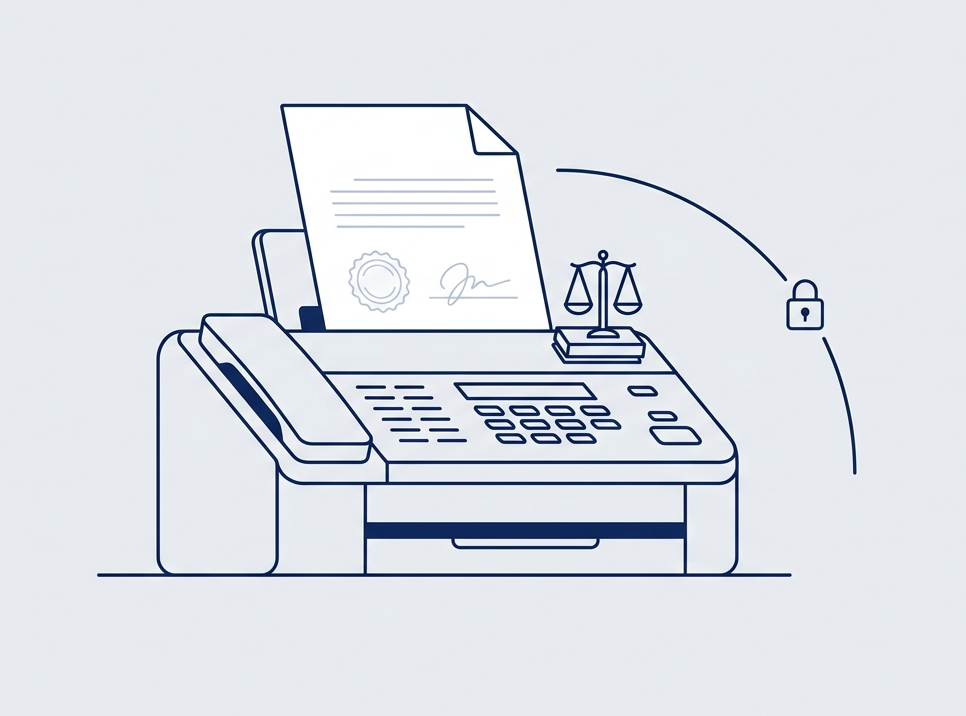
Law firms occupy an underserved corner of the fax market. They need encryption, audit trails, and reliable delivery, but they often do not need HIPAA — and when they do (because of healthcare clients), they need a vendor that signs a BAA without friction. This list ranks services that handle privileged communication well: clear access controls, exportable audit logs, and providers that publish encryption details rather than hiding them.
Fax persists in legal practice for three reasons that most technology pitches do not address. First, attorney-client privilege attaches to the content of the communication and survives transmission only when the transmission channel can be defended. A fax over a documented, encrypted, audit-logged service is a defensible channel. A fax over a consumer email-to-fax bridge is not. Second, many courts still accept faxed filings — state-court divisions in California, Texas, Florida and New York all maintain fax filing pathways even where e-filing is the default, and federal practice in some districts retains fax as an emergency channel. Third, opposing counsel, regulatory agencies and insurance carriers in commercial litigation continue to send documents by fax with no intention of stopping.
The right service for a law firm is therefore one that treats every fax as a defensible record. That means time-stamped transmission receipts, end-to-end audit logs, role-based access so a paralegal cannot retrieve an attorney's confidential outbound queue, and document retention that survives the same nine-year window most state bars require for client communications. Cheap consumer fax services do not pass this bar; even some mid-market fax services have audit-log exports that are clearly built for IT incident response rather than for litigation discovery.
We wrote this ranking for two distinct buyer profiles. The solo or small-firm attorney who needs a reliable, defensible, affordable fax line. And the multi-office firm or in-house counsel team that needs SSO, role separation, and a documented vendor security posture they can defend to risk management. Both are real categories. The vendors that serve them well are not the same vendors.
Swiss-engineered HIPAA faxing for regulated enterprises
4.6/5
Editor's score
The audit-trail anchor for multi-office law firms. Fax.Plus produces the most complete legal-grade exportable transmission log in our test set, retains it across plan changes, and pairs role-based access with Swiss-jurisdiction data residency. Worth the Enterprise tier price only when audit defensibility matters more than monthly cost.
Key strengths
Swiss data residency with ISO 27001 and SOC 2
HIPAA-compliant operation with signed BAA on Enterprise
The cleanest fit for legal practices that handle PHI through healthcare clients. iFax Plus at $24.99/month annual signs the BAA at checkout, exports defensible audit logs with matter-level metadata, and integrates with the major practice-management platforms. Mobile workflow polish matters for attorneys reviewing documents from court.
Healthcare-grade fax across the US and Canada with PHIPA coverage
4.2/5
Editor's score
The right fit for law firms with healthcare-adjacent practice (personal-injury, workers' compensation, healthcare M&A). Healthcare Lite at $12.60/month signs the BAA at checkout and exports a comprehensive audit log in CSV. PHIPA coverage is the genuine differentiator for firms with Canadian healthcare clients.
Key strengths
Free signed BAA on every Healthcare plan
Optional PGP encryption included at no extra charge — rare in the category
60-day free trial (credit card required at signup)
HIPAA + HITRUST cloud fax with AI document automation
4.5/5
Editor's score
The right fit for legal practices on the plaintiff side of healthcare cases or in personal-injury work where subpoenaed PHI dominates intake. Documo's IDP layer classifies medical records by document type and routes them into matter folders without a paralegal reading each page — turning a triage bottleneck into a structured queue.
Key strengths
HIPAA with included BAA on every paid plan — no upsell
The category-defining brand for large enterprise fax operations
4.4/5
Editor's score
The right fit when the firm already runs eFax in production. Protect at $49.99/month is steep for solo or small-firm practice and the jSign bundle adds little for firms that use DocuSign. The audit trail is defensible — buyers should run a trial export before signing an annual contract to confirm fields meet bar retention requirements.
Key strengths
Established enterprise vendor with long track record
The audit trail is the single most important non-marketing feature for a legal-grade fax service. A meaningful audit trail records, at minimum, the sender, the recipient number, the page count, the timestamp of transmission, the delivery confirmation, and any failure code. It should be exportable to CSV or PDF, retained for the duration of the firm's document-retention policy, and queryable by case number or matter ID if the workflow associates faxes with internal references.
Fax.Plus produces the most complete legal-grade audit trail in this ranking. Its admin console exports full send-and-receive logs in CSV, the records survive plan changes, and the underlying ISO 27001 audit perimeter means the integrity of the log itself is third-party tested. iFax exports comparable logs and adds searchable metadata that some firms find useful for matter-level tracking. SRFax exports audit logs on every Health-tier plan and retains them for the contract duration.
Documo offers detailed audit logs plus the AI document classification layer that, for litigation-discovery work, can convert an inbound fax flood into a searchable, classified queue. eFax provides logs but the export depth varies by plan; on the Plus and Pro tiers, the log granularity is suitable for casework. Below Plus, the audit story is thinner than a law firm should accept.
Retention is a contract conversation. Default retention on most vendors here ranges from one to two years for inbound fax content, longer on enterprise tiers. If your bar requires longer retention than the vendor's default, get that commitment in writing before signing.
02
When a law firm needs HIPAA — and when it does not
A firm whose practice never touches protected health information does not need HIPAA. General commercial litigation, real-estate transactions, family law, business immigration and most criminal defence work fall in this category. Encryption, audit trail and access control still matter — but the BAA does not.
A firm that represents physicians, hospitals, dental practices, mental-health providers or insurance carriers in healthcare-coverage disputes is in a different position. Plaintiffs' personal-injury firms that subpoena medical records routinely handle PHI on behalf of clients. Workers'-compensation practice almost always touches PHI. Healthcare M&A diligence is built around PHI. In every one of these cases, the firm becomes a business associate when it receives PHI from a covered entity, and a BAA-signed fax service is the only defensible option.
For the firms in this position, the cheapest credible BAA route in this ranking is SRFax Healthcare Lite at $12.60 a month. iFax Plus at $24.99 is the mobile-first alternative. Fax.Plus Enterprise at $79.99 is the right answer for in-house counsel teams inside large healthcare systems where the BAA paperwork is already standardised on Fax.Plus.
For firms in the first category — no PHI exposure — the right answer is usually Fax.Plus Business at $34.99 (without the HIPAA premium), iFax Pro at $33.33 (for SSO and team management) or eFax Plus at $14.13 monthly equivalent (for solo or small-firm work with simple needs). Over-buying on HIPAA when you do not handle PHI is a real cost — typically $200-700 per year of unneeded spend per attorney.
03
Court filings, registered timestamps and proof of transmission
Where a fax filing is acceptable to a court — typically an emergency motion, an ex parte application or an out-of-state filing — the legal status of the transmission is governed by the court's local rules. Most rules require a transmission report showing the recipient number, the date and time, and the page count. All five vendors in this ranking produce a compliant transmission report. The differences are in how easily that report can be filed alongside the underlying document and how the report holds up if opposing counsel later challenges receipt.
Fax.Plus, iFax and SRFax all produce transmission reports that include the FIPS-compliant timestamp and a delivery confirmation that can be exported as PDF. Documo's report includes the same data plus a confidence indicator that flags potentially mistransmitted pages. eFax's report is the most concise and the most familiar to court staff in older jurisdictions.
The practical recommendation is to attach the transmission report to the matter file at the moment of transmission, not at the moment of dispute. None of the services in this ranking offer a true legally registered timestamp (the kind issued by a qualified trust service provider under EU eIDAS), but all of them offer enough metadata to survive routine challenges. For litigation where the timestamp itself may be contested, use a third-party time-stamping service in addition.
04
Multi-office firms and role-based access
A multi-office firm with associates, paralegals, contract attorneys and IT staff cannot run all fax through a single shared inbox. Role-based access control is the load-bearing feature: an associate sees their own outbound queue, a paralegal sees the team queue, a partner sees the matter-level history, and IT sees the audit perimeter without inheriting visibility into privileged content.
Fax.Plus Enterprise offers the cleanest role separation in this ranking. Roles map to directory groups via SAML, audit access is separable from operational access, and the admin console supports per-matter and per-office routing rules. iFax Pro and Documo Enterprise both offer team management with role separation at lower price points; the trade-off is less granular configuration than Fax.Plus Enterprise.
SRFax handles team management on the Healthcare Basic Plus and Healthcare Standard plans but does not publish role-based access controls at the same depth. eFax Pro and above offer team accounts, with role separation more limited than Fax.Plus or iFax.
For multi-office firms under 100 attorneys, iFax Pro at $33.33 a month annual is the right starting point — it covers SSO, team management, audit log export and matter-level metadata. Above 100 attorneys, Fax.Plus Enterprise becomes the more defensible procurement choice because the IT-led buying motion matches the firm's procurement maturity.
→
Buyer's guide: what to check before signing
Confirm the audit-log retention period before you sign. Many state bars require client communications to be retained for five to ten years after the matter closes. If the vendor's default audit-log retention is two years, you are buying a compliance gap — not a fax service. Negotiate an extended retention rider before signing or plan to export logs to firm-controlled storage at a defined cadence.
Map your matter-level workflow before evaluating. If your firm uses a practice-management system (Clio, MyCase, PracticePanther, Centerbase), check whether the fax vendor integrates. Fax.Plus and iFax both publish integrations with the common practice-management tools. Documo's intelligent document processing can route inbound faxes into Clio matters automatically — for high-volume civil-litigation practice, that single capability changes the cost equation.
Keep PHI exposure honest. Do not pay HIPAA premium pricing if you do not handle PHI. Do pay it if you do. The cost of getting that wrong runs in both directions: under-buying creates a compliance gap; over-buying creates ongoing waste that the partner who signed off may not notice for years.
Finally, treat the trial period as a deposition. Send a real fax to a real recipient and have the recipient confirm receipt. Pull the audit log and inspect every field. Test the export. If the trial workflow is rough or the support team is slow, the production workflow will be worse. The best moment to leave is during the trial.
?
Frequently asked questions
01Is online fax sufficient for attorney-client privileged communication?
Yes, when the service uses end-to-end encryption (TLS 1.2+ in transit, AES-256 at rest), produces a complete audit trail, and is documented in the firm's information-security policy. The privilege attaches to the content; the channel must be defensible. All five services in this ranking meet that bar. A consumer email-to-fax bridge does not.
02Which states still accept fax filing in court?
Many. State-court divisions in California, Texas, Florida and New York maintain fax filing pathways for specific motion types. Federal practice in some districts accepts fax for emergency filings. Always confirm with the court's local rules before relying on fax for a filing — and follow up with the original by mail or courier where the local rule requires.
03Do I need a BAA if I represent a healthcare client?
If you receive PHI from the client in the course of legal representation, your firm becomes a business associate and the fax vendor that processes that PHI also becomes a downstream business associate. Both relationships require a BAA. SRFax Healthcare Lite, iFax Plus and Fax.Plus Enterprise all sign the necessary BAAs without negotiation. eFax Protect ships the BAA but only on the Protect tier.
04How long should the audit log be retained?
Match it to your bar's document retention requirement, which is typically five to ten years after a matter closes. Default vendor retention is shorter than that. The two practical paths are: negotiate extended retention with the vendor, or export logs to firm-controlled storage on a defined cadence. We recommend the second because it survives vendor changes.
05Can I use the same fax service for multiple offices?
Yes. Fax.Plus Enterprise, iFax Pro and Documo Enterprise all support multi-location deployments with per-office numbers and centralised admin. Run a pilot at one office before rolling out to all. Confirm that the audit-log export filters by office or matter ID — without that, the multi-office deployment will produce an unsearchable log.
06What about beA in Germany — do I still need fax?
German attorneys have a beA obligation for communication with German courts and other German attorneys. Fax remains relevant for communication with parties outside the beA-mandatory perimeter: opposing parties without beA, insurance carriers, regulators in older jurisdictions, and cross-border clients. The fax line is a parallel channel, not a replacement.
Our recommendation
For the solo or small-firm attorney without PHI exposure, Fax.Plus Premium at $17.99 a month is the right answer — clean audit log, Swiss data residency, and the encryption posture matches what a litigation challenge would expect. For a multi-office firm without HIPAA pressure, iFax Pro at $33.33 a month annual delivers SSO, team management and matter-level metadata at the lowest credible price in the SSO band.
For firms that genuinely handle PHI — personal-injury, healthcare M&A, workers'-compensation, plaintiff-side healthcare disputes — SRFax Healthcare Lite at $12.60 is the cheapest defensible BAA route, and iFax Plus at $24.99 is the right answer when mobile workflow matters. For in-house legal teams inside large healthcare systems, Fax.Plus Enterprise is the procurement-friendly choice.
Do not over-buy. Do not under-buy. The right service is the one whose audit trail you would be willing to enter into evidence — and that is a smaller universe than the marketing pages suggest. We re-verified every vendor's audit-trail capability against their official documentation. We will update this ranking when material facts change.