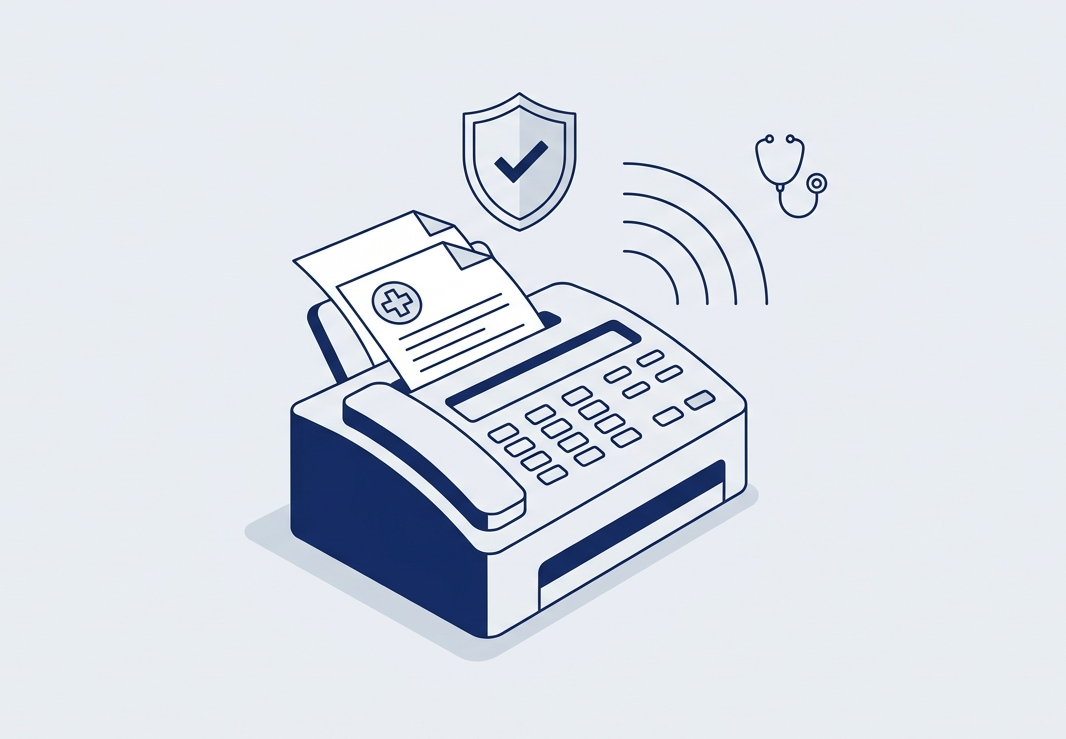
Editorial ranking of online fax services for healthcare practices, hospitals, and clinics that need a signed BAA, audited security, and a workflow that holds up under HIPAA scrutiny.
Editorial: FaxChoice Editors
Updated June 21, 2026
Editor's quick answerJune 21, 2026
Best overall
Fax.Plus
Swiss-engineered HIPAA faxing for regulated enterprises
Healthcare faxing is a compliance problem first and a usability problem second. Any cloud-fax service used to transmit protected health information must be backed by a Business Associate Agreement (BAA), encrypted in transit and at rest, audit-logged, and operated under documented access controls. We evaluated nine services against that bar and ranked the seven that meet it. The two excluded from this ranking — MetroFax and Nextiva vFax — do not market HIPAA-compliant operation on their standard plans and should be treated as unsuitable for PHI workflows.
Fax remains the most common method by which healthcare practices send protected health information between providers, insurers, pharmacies and back-office vendors. The Centers for Medicare & Medicaid Services still accept fax as a primary transmission channel for prior authorisations, lab orders and referral paperwork. Replacing it with secure portals, direct messaging or APIs has been the goal of every healthcare-IT vendor for two decades. None of them have managed it. Cloud fax is the practical compromise — it modernises the operational surface while preserving the workflows that hospitals, clinics and labs already run.
The stakes are higher than they look. A single misdirected fax containing PHI can trigger a breach notification under the HIPAA Security Rule. The Office for Civil Rights has settled enforcement actions against practices that used non-compliant fax systems, including penalties for transmissions sent over consumer email-to-fax services without a Business Associate Agreement. Selecting the wrong vendor is not a minor procurement decision — it is a compliance exposure that can cost more than the entire fax line item for the year it covers.
We wrote this ranking for the buyer who has to make that decision and explain it to a compliance officer afterward. Every entry below sits on a service whose HIPAA posture we verified against the vendor's own published Trust Center, security documentation or BAA addendum. Where a vendor only signs a BAA on a specific tier or via a related product, we say so. Where a vendor advertises HIPAA compliance but does not back it with a published independent audit, we say that too. Editorial trust is the product. We do not accept paid placements from any vendor in this list.
Swiss-engineered HIPAA faxing for regulated enterprises
4.6/5
Editor's score
The most procurement-friendly HIPAA option for hospitals and multi-site healthcare networks. The Enterprise tier at $79.99/month is the only one that signs a BAA — solo clinicians should look elsewhere — but it pairs the BAA with Swiss data residency, ISO 27001, SOC 2 Type 2 and an audited operational stack that survives the most demanding hospital security review.
Key strengths
Swiss data residency with ISO 27001 and SOC 2
HIPAA-compliant operation with signed BAA on Enterprise
HIPAA + HITRUST cloud fax with AI document automation
4.5/5
Editor's score
The HITRUST-certified pick. Documo is the only fax vendor in this category that explicitly holds HITRUST CSF — the strongest signal a hospital security review can ask for. Every paid plan ships a free BAA; the Custom tier adds Intelligent Document Processing that classifies inbound faxes and routes them into PointClickCare, ModMed and NextGen automatically.
Key strengths
HIPAA with included BAA on every paid plan — no upsell
Healthcare-grade fax across the US and Canada with PHIPA coverage
4.2/5
Editor's score
The compliance-per-dollar leader for solo healthcare. Healthcare Lite at $12.60/month signs the BAA, includes optional PGP encryption at no extra cost, and ships PHIPA coverage for Ontario practices and US-CA cross-border operators. Web-only — no native mobile app — so this is a desktop-first pick for the records-room workflow, not a phone-driven one.
Key strengths
Free signed BAA on every Healthcare plan
Optional PGP encryption included at no extra charge — rare in the category
60-day free trial (credit card required at signup)
The healthcare workflow pick. iFax Plus at $24.99/month annual ships a free BAA, the HIPAA Seal of Compliance, eSign and OCR. The iOS and Android apps are the strongest in the category — built-in scanner, mobile signature flow, inbound classification. Best fit for solo practices and small clinics where intake happens on a phone, not a desktop.
The category-defining brand for large enterprise fax operations
4.4/5
Editor's score
The brand-recognition incumbent. eFax Protect at $49.99/month signs the BAA and bundles jSign (HITRUST-certified eSignatures); Corporate adds HITRUST CSF. Pricier than iFax or SRFax for the same HIPAA bar, but the right answer for hospital systems already standardised on eFax across multiple sites where migration cost outweighs the per-month gap.
Key strengths
Established enterprise vendor with long track record
The brand-recognition healthcare option for practices already inside the Dropbox ecosystem. HIPAA coverage runs through a paired Dropbox Sign Standard or Premium subscription, which signs the BAA (minimum-contract gate added June 2024). For practices not already on Dropbox Sign, iFax Plus or SRFax Healthcare Lite is the cleaner direct path.
Key strengths
Brand recognition of Dropbox — a household name with 700M+ registered users
Deep compliance stack: HIPAA, HITECH, SOC 2 Type 2, SOC 3, ISO 27001, ISO 27018, PCI DSS, GDPR
The UCaaS-native HIPAA option. Standard plans are not HIPAA-compliant, but Nextiva sells a separately-priced HIPAA-compliant vFax tier through enterprise sales with a signed BAA — covering fax, voice and video under one programme. Email-to-fax is disabled on the HIPAA tier; inbound documents arrive in a secure portal.
Key strengths
Entry plan at $7.95/month for 500 pages
HIPAA-compliant tier available with signed BAA — covers fax, voice, and video
Budget-friendly online fax with broad compliance coverage
4.1/5
Editor's score
The budget-end healthcare option. CocoFax markets HIPAA + PHIPA compliance but the BAA must be requested manually and the security stack is not backed by an independent SOC 2 or HITRUST audit. Suitable only for very low-volume practices where the price difference vs SRFax Healthcare Lite or iFax Plus is worth the documentation gap.
Key strengths
Lowest entry price in the category at $4.99/month
Triple compliance positioning: HIPAA, GDPR, PHIPA
iOS and Android apps included on every plan
Starting price
$4.99/mo · annual billing
HIPAA + BAA
Included
Best for
Budget-conscious·Small business·Freelancers
01
How we evaluated each service
Six criteria carried the weight in this ranking. First, the Business Associate Agreement: is it signed at the entry tier, or does the buyer need to climb to an enterprise plan? Second, the security envelope: SOC 2 Type 2, ISO 27001 and HITRUST are the three certifications a compliance officer expects to find on a vendor questionnaire. Third, the encryption posture: AES-256 at rest and TLS 1.2+ in transit are the floor — anything weaker is disqualifying for PHI. Fourth, the audit trail: every fax must be logged, exportable and tied to a user. Fifth, the access controls: role-based permissions, MFA and SAML SSO matter more as headcount grows. Sixth, the operational details that come up only in production — number porting, BAA turnaround, support availability, plan ceilings before overage kicks in.
We also evaluated value separately from compliance. A signed BAA at $12.60 per month is not the same offer as a signed BAA at $79.99 per month, even if both are technically HIPAA-compliant. Buyers should weigh feature ceilings against operational realities. A 200-page healthcare plan suits a solo psychotherapist; it will not survive at a busy multi-location urgent-care clinic.
02
What HIPAA actually requires from a cloud fax vendor
HIPAA does not certify products. The phrase 'HIPAA-compliant fax' is a vendor claim, not a regulatory stamp. What HIPAA actually requires is a Business Associate Agreement between the covered entity and the vendor, plus operational controls that satisfy the Security Rule. The BAA is the legally binding instrument; the controls are the proof. Without both, the relationship is non-compliant regardless of how the vendor markets the product.
The Security Rule breaks down into three control families. Administrative safeguards cover policies, training, breach notification and the business associate relationship itself. Technical safeguards cover access control, audit controls, integrity controls and transmission security — the encryption and logging layer. Physical safeguards cover facility access, workstation security and device controls. A cloud fax vendor inherits most of the physical safeguards through its data-centre operator, but the administrative and technical controls live in the product.
This is why HITRUST CSF certification carries weight. HITRUST consolidates HIPAA, NIST 800-53, ISO 27001, PCI DSS and other frameworks into a single auditable certification. A HITRUST-certified vendor has gone through a third-party audit that explicitly maps to HIPAA Security Rule requirements. SOC 2 Type 2 is the second-best signal — it covers operational controls but does not map specifically to HIPAA. ISO 27001 is the third — broad information security with overlap. A vendor that publishes all three is doing the homework. A vendor that publishes none and still markets HIPAA compliance is asking the buyer to take their word for it.
03
When the cheapest BAA is the right BAA — and when it isn't
SRFax at $12.60 per month for the Healthcare Lite plan is the cheapest signed-BAA route in this ranking. For a solo psychotherapist sending occasional referral confirmations, that price is honest. The plan includes the BAA, free PGP encryption, audit logs, ISO 27001 and SOC 2 controls and a 60-day free trial. There is no reason for a one-clinician practice to pay more.
The equation changes the moment volume grows. A two-doctor primary-care clinic that processes 600 referrals a month will pay overage charges on Healthcare Lite within two weeks. The right choice is Healthcare Basic Plus at $22.95 or Healthcare Standard at $41.35 — still cheaper than the eFax Protect tier and with a more transparent operational model.
For a multi-site practice, the calculus shifts again. iFax Plus at $24.99 buys a polished mobile workflow and built-in eSign, which matter when staff members move between locations. Documo at $25 brings HITRUST and AI document processing, which matter when the inbound queue exceeds what humans can triage. Fax.Plus Enterprise at $79.99 is procurement-friendly and adds SSO + data residency, which only matter once IT becomes the buyer.
The wrong move is to default to the cheapest plan because compliance is technically covered. A $12.60 plan that runs out of pages in week three and forces the practice manager to fall back on consumer email-to-fax is a $20,000 compliance exposure waiting to happen.
04
PHIPA, Canadian healthcare, and cross-border practices
Ontario's Personal Health Information Protection Act (PHIPA) is the closest Canadian analogue to HIPAA. It applies to health information custodians in the province and carries its own breach-notification regime. Two services in this ranking — SRFax and CocoFax — explicitly market PHIPA coverage. SRFax is Canadian-built; its Healthcare plans are designed around PHIPA from day one, with audit logs, role-based access and a signed agreement equivalent in scope to a BAA. CocoFax advertises PHIPA but does not publish an independent audit, which is enough of a caveat to flag for cross-border buyers.
For practices in Ontario, Quebec, British Columbia or any other province that runs cross-border referrals into the US, SRFax is the practical pick. For practices that operate entirely within the US, PHIPA coverage adds no value and HIPAA-only services like iFax, Documo or Fax.Plus are usually a better feature fit. The decision is straightforward only if you know which laws you owe.
→
Buyer's guide: what to check before signing
Before you sign anything, get the BAA in writing and read it. Confirm three specifics: who counts as the business associate on the agreement, what the breach-notification timeline is, and what the data-disposition policy looks like if you cancel. Verify the encryption claim independently — every vendor in this list publishes the cipher inventory in their Trust Center or security documentation. If the Trust Center is empty or login-gated, that is a signal worth flagging.
Ask the vendor what happens to PHI after termination. Documo, Fax.Plus and SRFax document the deletion process with specific timelines. Some smaller vendors do not. If your compliance officer cannot quote the data-disposition policy from memory by week two of the engagement, the engagement is not properly scoped.
Measure your actual page volume for two months before locking in a plan. Most healthcare buyers under-estimate by 30-50%. A 200-page Solo plan that looks comfortable in the demo runs into overage in the second month of production use. Use that real number to size the plan, not the plan brochure.
Finally, watch for the upgrade path. SRFax Healthcare Lite to Healthcare Basic Plus is a clean step. iFax Basic to Plus crosses the compliance boundary — Basic is send-only and does not include the BAA, which means you cannot start there. Fax.Plus has no HIPAA on Basic, Premium or Business — only Enterprise carries the BAA. Knowing the threshold before you sign saves a procurement reset six months in.
?
Frequently asked questions
01Does HIPAA require a specific encryption standard for fax?
HIPAA does not name a cipher, but the HHS guidance points to NIST 800-111 for data at rest and FIPS 140-2 validated modules for data in transit. In practice, every vendor in this ranking uses AES-256 at rest and TLS 1.2 or higher in transit. Anything less than that should be disqualifying for PHI.
02Can I use a consumer email-to-fax service if it has SSL?
No. SSL or TLS in transit is necessary but not sufficient. Without a signed Business Associate Agreement, the relationship is non-compliant under HIPAA regardless of how the underlying connection is encrypted. The OCR has settled enforcement actions against practices that relied on this misunderstanding.
03Which is more credible: SOC 2 Type 2, ISO 27001 or HITRUST?
For healthcare specifically, HITRUST CSF is the strongest signal because it maps directly to HIPAA Security Rule controls. SOC 2 Type 2 is the second-strongest — it covers operational controls but not HIPAA-specific mapping. ISO 27001 is third — broad information-security coverage with overlap. Most enterprise procurement teams will accept SOC 2 Type 2 alone. Hospital security reviews typically expect at least two of the three.
04Does a BAA cover incidents caused by my own staff?
No. A Business Associate Agreement only allocates liability between the covered entity and the business associate. Staff training, access controls and breach response are the covered entity's responsibility. A signed BAA does not absolve a practice of misdirected-fax liability if the misdirection came from a workforce member.
05How long does BAA execution typically take?
On services that ship BAAs at the entry tier — Documo, iFax Plus, SRFax Healthcare — the BAA is signed instantly during checkout or sent for counter-signature within 24-48 hours. On enterprise-only BAA services like Fax.Plus and eFax Protect, the turnaround is typically one to two weeks because the contract runs through sales. Build that into the procurement timeline.
06Should I be worried that my service does not list HITRUST?
It depends on your environment. Documo is the only service in this ranking that holds HITRUST. iFax, SRFax and Fax.Plus all hold SOC 2 Type 2 plus ISO 27001 — that combination is sufficient for the vast majority of healthcare procurement reviews. If your security review specifically asks for HITRUST and your fax vendor cannot supply it, Documo is the alternative to evaluate.
Our recommendation
For most healthcare practices in 2026, the right answer is iFax Plus at $24.99 a month. It signs a BAA at the entry tier, ships best-in-class mobile apps, includes eSign and OCR, holds the HIPAA Seal of Compliance, and adds SOC 2 Type 2 plus ISO 27001 on the Professional tier. Solo practices and very small clinics will pay less and stay compliant on SRFax Healthcare Lite at $12.60. Hospitals and multi-site networks should start with Documo for the HITRUST stack or Fax.Plus Enterprise for IT-led procurement.
The wrong choice is to default to the cheapest signed BAA without sizing the plan. The right choice is to match the operational profile — solo, small-team, multi-site or enterprise — against the published BAA path, certification stack and overage curve. We re-verified every vendor's HIPAA position against their official documentation. We will update this ranking when material facts change.